

Answer Summary
DME providers optimize inventory by aligning stock movement with real-time authorization status and segmenting equipment by usage velocity to ensure capital isn’t locked in unbillable assets. This strategic coordination is vital in 2026 as providers aim for a 15% reduction in carrying costs to offset tightening reimbursement margins and unpredictable payer cycles. By transitioning from static par levels to data-driven reorder points, facilities maintain high service levels while significantly improving overall cash flow predictability.
Introduction: Why Inventory Became a Financial Risk, Not Just an Operations Issue
For many DME providers, inventory management has historically been treated as a logistical function—ensuring products are available when patients need them. In 2026, that view is no longer sufficient.
Inventory decisions now directly affect cash flow, audit exposure, and operational flexibility. Carrying excess equipment ties up capital during periods of reimbursement delay, while understocking creates service disruptions, rushed purchasing, and documentation shortcuts that increase denial risk.
The challenge for DME providers is no longer “having enough inventory.” It is aligning inventory levels with real demand, reimbursement timing, and operational capacity.
This rapid solver focuses on practical strategies providers can apply immediately to regain control.
Problem One: Overstocking Driven by Unpredictable Reimbursement
Many providers responded to payer delays and supply-chain uncertainty by increasing inventory buffers. While
understandable, this approach introduced new risks.
Excess inventory:
- Ties up working capital
- Increases storage and handling costs
- Raises risk of obsolescence
- Complicates inventory reconciliation during audits
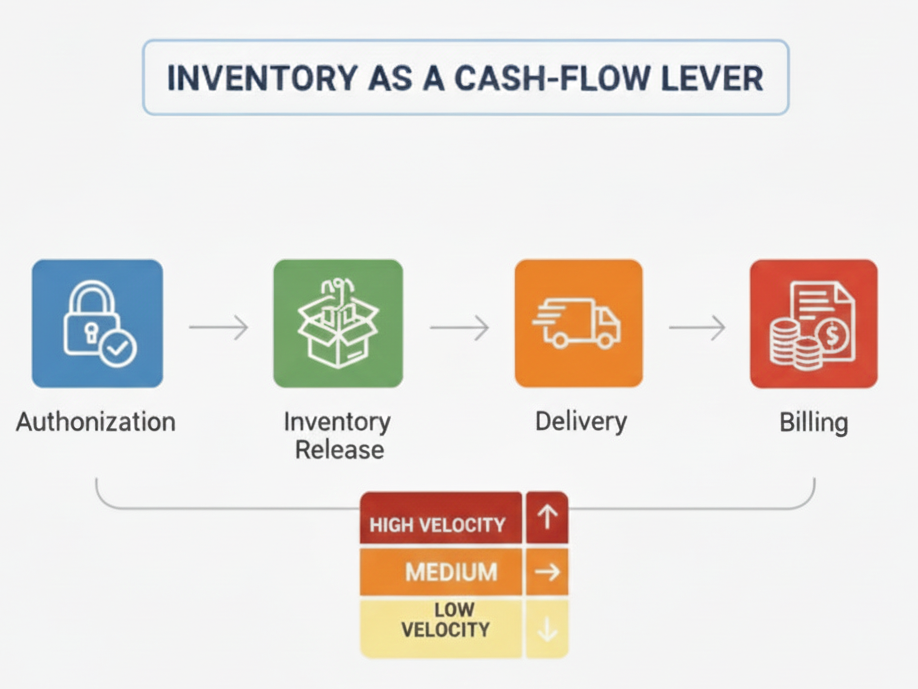
In an environment where payment timing is uncertain, inventory becomes a cash-flow lever—not just a supply concern.
Strategy 1: Segment Inventory by Velocity, Not Category
One of the most effective inventory controls is segmentation based on usage velocity.
Instead of grouping inventory solely by product type, providers should classify items as:
- High-velocity (frequent, predictable demand)
- Medium-velocity (moderate demand, some variability)
- Low-velocity (specialty or infrequent items)
High-velocity items benefit from tighter reorder points and smaller safety stock. Low-velocity items often require just-in-time ordering rather than shelf space.
This approach reduces overstocking without increasing stockouts.
Problem Two: Inventory Decisions Made Without Billing Context
Inventory teams often operate independently from billing and revenue-cycle functions. This separation creates blind spots.
Common issues include:
- Purchasing equipment before authorization approval
- Delivering items without clear billing timelines
- Holding equipment tied to unresolved documentation
When inventory decisions ignore billing realities, equipment sits unused while capital remains locked.
Strategy 2: Align Inventory Triggers With Authorization Status
Inventory movement should be tied to authorization and documentation readiness—not just anticipated demand.
Best practices include:
- Linking inventory release to confirmed authorization
- Flagging items tied to pending documentation
- Preventing delivery scheduling until billing prerequisites are met
This alignment reduces the risk of delivered-but-unbillable equipment and improves cash predictability.
Problem Three: Manual Tracking Masks True Inventory Exposure
Spreadsheets and manual counts struggle to keep pace with multi-location operations and high transaction volume. Errors accumulate quickly.
Manual tracking often leads to:
- Inaccurate on-hand counts
- Missed reorder signals
- Delayed identification of slow-moving stock
These gaps make inventory appear more controlled than it actually is.
Strategy 3: Use Data-Driven Reorder Points Instead of Fixed Par Levels
Static par levels assume stable demand—an assumption that rarely holds in DME operations.
Data-driven reorder points adjust dynamically based on:
- Historical usage
- Seasonal demand patterns
- Delivery lead times
- Reimbursement timing
By recalibrating reorder thresholds regularly, providers avoid both shortages and excess stock.
Problem Four: Slow-Moving Inventory Goes Unaddressed
Obsolete or slow-moving equipment quietly erodes margins. Many providers delay action because disposal or redistribution feels disruptive.
In reality, inaction is more costly.
Strategy 4: Perform Quarterly Inventory Velocity Reviews
Quarterly reviews help identify:
- Items with declining usage
- Equipment tied to discontinued services
- Products with excessive dwell time
Once identified, providers can:
- Redistribute across locations
- Reduce future purchasing
- Liquidate or return where possible
Regular review prevents inventory creep.
Problem Five: Inventory Errors Create Audit and Compliance Risk
Inventory discrepancies are not just operational issues—they affect audit defensibility.
Delivered equipment that is not reconciled with billing records raises red flags during reviews. Inconsistent records undermine credibility.
Strategy 5: Reconcile Inventory and Billing Data Routinely
Providers should ensure:
- Delivered equipment is matched to billed claims
- Returned or swapped items are documented
- Inventory systems align with billing systems
Under 42 CFR § 424.57, suppliers are responsible for accurate records related to services billed. Clean inventory records support compliance as well as operations.
Strategy 6: Treat Inventory as a Cash-Flow Tool
In 2026, inventory decisions must reflect cash realities.
Providers should:
- Adjust purchasing during reimbursement slowdowns
- Delay nonessential stock expansion
- Model inventory spend against expected payment timing
Inventory optimization is as much a financial discipline as an operational one.
Common Inventory Optimization Mistakes to Avoid
Providers often struggle when they:
- Apply one-size-fits-all inventory rules
- Ignore billing and authorization dependencies
- Fail to review slow-moving stock regularly
- Overcorrect and create avoidable stockouts
Optimization requires balance, not extremes.
How Wonder Worth Solutions Helps
Wonder Worth Solutions helps DME providers align inventory strategy with billing workflows, authorization readiness, and cash-flow planning. By integrating operational data with revenue-cycle insight, providers gain control without sacrificing service reliability.
Conclusion
Inventory optimization in 2026 is not about carrying less—it is about carrying smarter. Providers that segment inventory by velocity, align movement with billing readiness, and use data-driven controls reduce carrying costs while protecting patient care. Inventory, when managed intentionally, becomes a stabilizing force rather than a financial liability.