
Answer Summary
DME coding mistakes in 2026 are less about knowledge gaps and more about inconsistent workflows, outdated references, and payer-specific rule complexity. Providers that standardize coding processes, align documentation, and monitor patterns proactively reduce denials, audit exposure, and revenue leakage.
Introduction: Why Coding Accuracy Is an Enterprise Risk
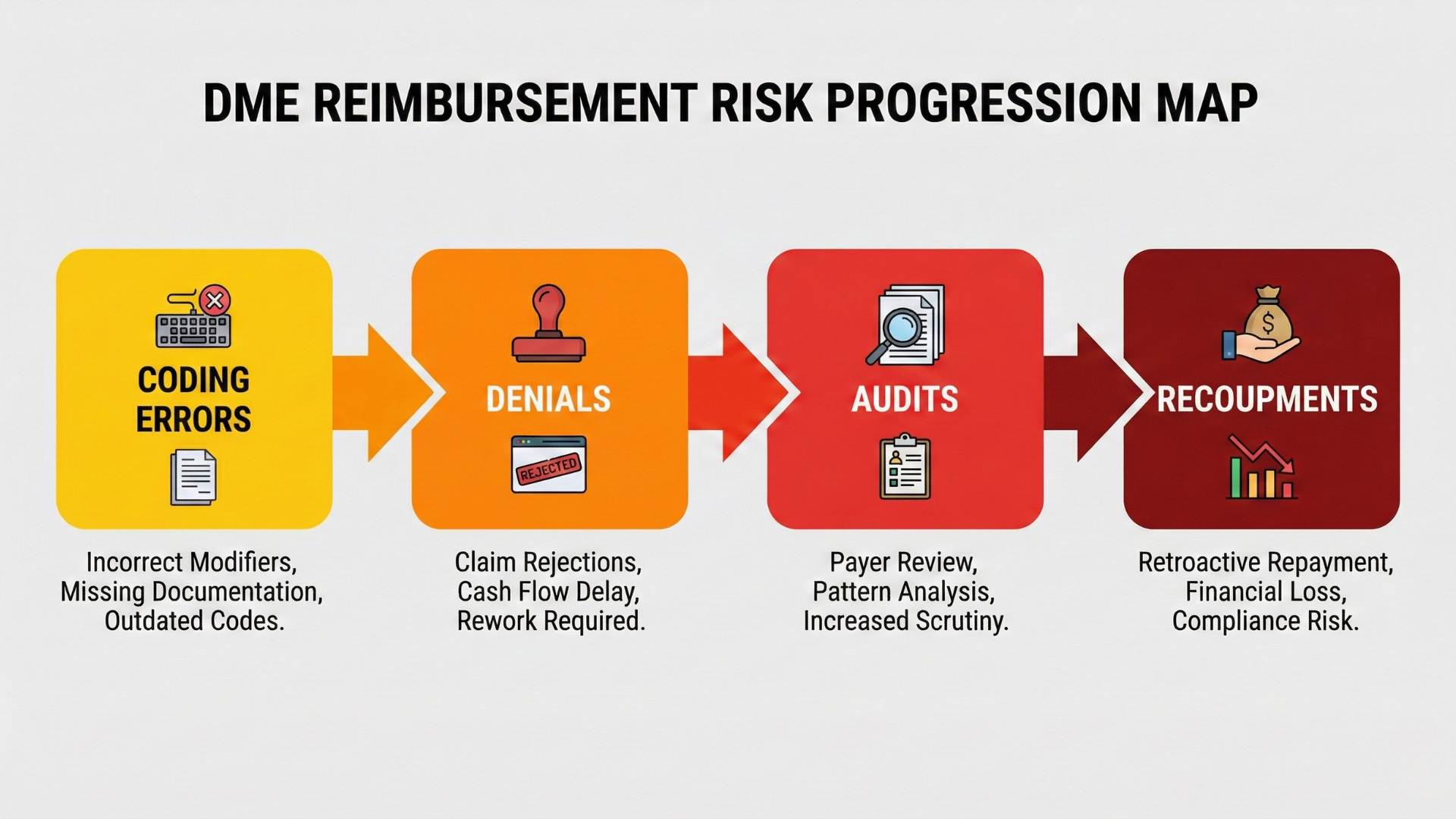
Coding errors have always caused denials. What’s changed is how aggressively payers analyze patterns.
In 2026:
- CMS and commercial payers rely heavily on automated edits
- Audits focus on consistency, not isolated claims
- Coding patterns influence pre-payment review and recoupment risk
Under 42 CFR § 424.57, DME suppliers are required to maintain accurate and accessible records that support billed services. Coding inconsistencies are now interpreted as process failures, not clerical mistakes.
This guide explains the most common DME coding errors, why they persist, and how providers can build accuracy into daily operations.
The Most Common Coding Errors DME Providers Still Make
Despite experienced teams, the same errors appear repeatedly:
- Incorrect or missing modifiers
- Documentation that does not clearly support billed codes
- Use of outdated code references or coverage assumptions
- Inconsistent interpretation of payer-specific rules
These errors compound when multiple billers, locations, or intake paths exist.
Why “It Paid Before” Is a Dangerous Strategy
One of the most common risk patterns auditors identify is historical reliance.
Claims that were paid previously may:
- Fall outside updated coverage criteria
- Trigger pattern-based audits later
- Create retroactive recoupment exposure
CMS and commercial payers do not evaluate claims in isolation. They evaluate behavior over time.
Medicare vs. Medicaid vs. Commercial Coding Risk
Coding risk varies by payer type:
Medicare
- Strong emphasis on documentation consistency
- High exposure to post-payment review
- Supplier Standards enforcement
Medicaid / MCOs
- State-specific and plan-specific policies
- Authorization and frequency mismatches
- Documentation format variability
Commercial Payers
- Aggressive automated edits
- Contract-specific modifier logic
- Pattern-based denial escalation
Coding accuracy must adapt to payer behavior—not just code sets.
Coding Errors as an Audit Trigger
Auditors frequently focus on:
- Repeated modifier misuse
- Documentation that does not match billed units
- Inconsistent coding across similar claims
Even when care is appropriate, inconsistent coding signals systemic weakness.
Building Coding Accuracy Into Daily Workflows
High-performing DME providers do not rely on individual memory.
They:
- Centralize coding guidance
- Standardize documentation requirements by product
- Align intake, clinical notes, and billing review
- Monitor denial trends by code and modifier
Accuracy becomes a process outcome, not a staff burden.
The Financial Cost of Coding Inconsistency
For a provider billing 4,000–6,000 claims per month:
- Small coding error rates create hundreds of denials
- Each denial consumes staff time and delays cash
- Audit exposure increases exponentially
Preventing errors upstream is significantly cheaper than fixing them later.
Leadership’s Role in Coding Risk
Coding accuracy reflects leadership priorities:
- Investment in standardization
- Ongoing education and monitoring
- Willingness to pause risky volume
Coding discipline is a governance issue, not just a billing task.
How Wonder Worth Solutions Helps
Wonder Worth Solutions helps DME providers design standardized, compliance-ready coding workflows that reduce variability, strengthen audit defense, and protect reimbursement.
Authoritative Resources Referenced
- 42 CFR § 424.57—DMEPOS Supplier Standards
- CMS Medicare Program Integrity Manual, Chapter 5
- CMS MLN Matters: Billing & Coding Guidance
- AAHomecare Coding & Compliance Resources
- ACHC Accreditation Standards
Conclusion
In 2026, coding accuracy is no longer about speed or experience alone. It’s about consistency, visibility, and alignment. Providers that treat coding as a system—not a task—protect both revenue and reputation.