Answer Summary
Accreditation audits are successfully managed by integrating continuous compliance into daily workflows, ensuring that documentation, staff training, and delivery records are always ready for unannounced surveys. This disciplined approach is vital in 2026 as CMS transitions from a three-year cycle to a mandatory annual accreditation requirement for all DMEPOS suppliers, a change that demands 365-day readiness to protect Medicare enrollment. By maintaining this perpetual state of alignment, providers can eliminate the high costs of reactive preparation while securing long-term operational stability.
Introduction: Why Accreditation Audits Feel Harder Every Year
For many DME providers, accreditation audits have become more stressful—not because the standards changed dramatically, but because operations have grown more complex. Multi-location workflows, staff turnover, new technology, and increased payer scrutiny all raise the stakes.
In 2026, accreditation audits are less about whether policies exist and more about whether daily operations align with those policies. Auditors are trained to look for consistency, documentation integrity, and evidence that processes are followed in practice—not just on paper.
This checklist is designed to help DME providers prepare proactively, reduce last-minute scrambling, and approach accreditation audits with confidence.
Accreditation Readiness Starts Before the Audit Is Scheduled
One of the biggest mistakes providers make is treating accreditation as a point-in-time event. Preparation should begin long before the audit notice arrives.
Providers that pass audits smoothly typically:
- Maintain standardized workflows year-round
- Keep documentation organized continuously
- Assign clear ownership for compliance tasks
Accreditation readiness is an operational discipline, not a seasonal project.
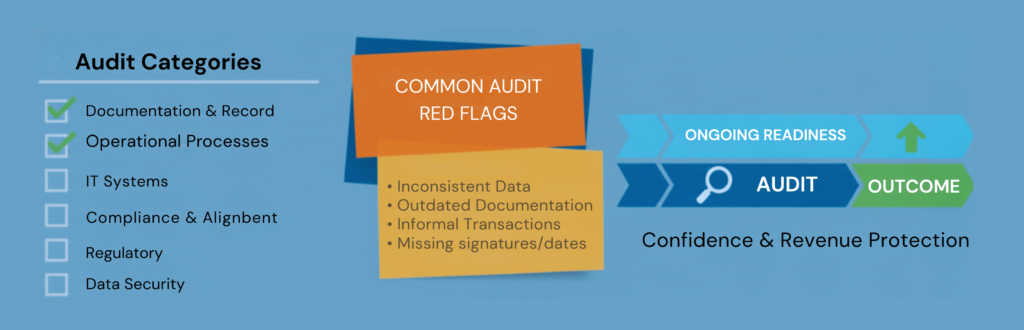
Checklist Section 1: Documentation & Record Management
Auditors will review documentation first. Gaps here often trigger deeper scrutiny.
Confirm that you can:
- Retrieve patient records quickly and completely
- Demonstrate medical necessity for items billed
- Show consistent documentation across intake, delivery, and billing
- Maintain records in accordance with 42 CFR § 424.57
Red flags include missing signatures, inconsistent dates, and documentation that does not clearly support the equipment provided.
Checklist Section 2: Policies, Procedures, and Evidence of Use
Having written policies is not enough. Auditors want evidence that staff follow them.
Verify that:
- Policies are current and reflect actual workflows
- Staff can describe procedures accurately
- Training records show initial and ongoing education
- Updates are documented and communicated
If staff “do it differently than the policy,” the policy is the problem.
Checklist Section 3: Intake and Order Processing Controls
Intake is a frequent source of compliance exposure.
Ensure that:
- Intake requirements are standardized
- Incomplete orders are not advanced downstream
- Authorization rules are enforced consistently
- Intake staff understand payer-specific requirements
Auditors often trace issues backward from claims to intake processes.
Checklist Section 4: Delivery and Proof-of-Delivery (POD)
Delivery documentation remains a common audit focus.
Confirm that:
- Proof-of-delivery is complete and legible
- Dates, signatures, and equipment details match billing records
- Delivery workflows are consistent across locations
- Returned or exchanged items are documented clearly
Any mismatch between delivery and billing invites scrutiny.
Checklist Section 5: Billing and Claims Alignment
Auditors review whether claims reflect what was actually delivered and documented.
Validate that:
- HCPCS codes match delivered equipment
- Modifiers are applied consistently
- Claims align with authorization parameters
- Corrections and resubmissions are documented
Billing accuracy supports both compliance and revenue stability.
Checklist Section 6: Staff Roles, Training, and Accountability
Accreditation bodies expect clarity around responsibility.
Ensure that:
- Staff roles are clearly defined
- Compliance responsibilities are assigned
- Training is role-specific and documented
- New staff receive onboarding before independent work
Overreliance on informal knowledge increases audit risk.
Checklist Section 7: Continuous Monitoring and Internal Reviews
Providers that pass audits smoothly often conduct internal reviews before auditors do.
Best practices include:
- Periodic chart audits
- Review of denial trends
- Spot checks of delivery and billing alignment
- Documentation of corrective actions
Auditors respond favorably to organizations that identify and address issues proactively.
Common Accreditation Pitfalls to Avoid
Providers frequently struggle when they:
- Prepare only after receiving audit notice
- Rely on outdated policies
- Assume past success guarantees future results
- Treat accreditation as separate from operations
Each of these increases audit stress and risk.
How Wonder Worth Solutions Supports Accreditation Readiness
Wonder Worth Solutions helps DME providers prepare for accreditation audits by aligning operational workflows with accreditation standards, identifying gaps before auditors do, and supporting continuous compliance readiness.
The goal is confidence—not crisis management.
Conclusion
Accreditation audits in 2026 are not about perfection—they are about consistency, documentation integrity, and operational alignment. Providers that integrate audit readiness into daily operations reduce stress, avoid surprises, and protect both compliance and revenue.
Preparation works best when it is ongoing.