Answer Summary
Resilient scaling in 2026 requires DME providers to engineer stability into their core workflows, ensuring that expanded volume does not amplify existing process fragilities or compliance gaps. As the industry faces a projected 15% increase in operational costs and tightening Medicare conversion factors, organizations must prioritize a “compliance-first” infrastructure to maintain first-pass claim acceptance rates above 95%. By standardizing intake and documentation before expanding, providers can protect their margins and ensure that growth leads to predictable revenue rather than increased audit exposure.
Introduction: Why Growth Became Risky for DME Providers
For many DME providers, growth has long been viewed as the primary solution to margin pressure. Expanding service areas, adding product lines, or increasing referral volume were expected to offset reimbursement challenges and rising operating costs. In earlier years, this assumption often held true.
By 2026, it no longer does.
Growth now magnifies weaknesses instead of masking them. Providers that scale without structural readiness find themselves facing higher denial rates, audit exposure, staffing instability, and cash-flow volatility. The same processes that functioned adequately at smaller volumes begin to fail under expansion.
Resilience has therefore become the prerequisite to growth. DME providers that can absorb disruption, adapt to payer behavior, and maintain operational control are the ones able to scale without increasing risk. Those that chase growth without resilience often discover too late that volume amplifies fragility.
What Resilience Actually Means in a DME Context
Resilience is often confused with efficiency or profitability. While related, it is distinct.
In DME operations, resilience refers to the organization’s ability to maintain stability despite disruption. These disruptions are no longer hypothetical—they are routine:
- Reimbursement delays
- Increased audit activity
- Staff turnover
- Supply-chain fluctuations
- Shifting payer requirements
A resilient organization absorbs these shocks without operational collapse. Claims continue to flow, documentation remains defensible, staff are not overwhelmed, and leadership retains visibility into performance.
Efficiency focuses on speed. Profitability focuses on margin. Resilience focuses on survivability under stress. Without it, scaling increases exposure rather than opportunity.
Scaling Without Structural Readiness: Where Providers Get Burned
Most scaling decisions begin with opportunity:
- A new payer contract
- A geographic expansion
- A high-volume referral source
- A new equipment category
What often goes unexamined is whether existing structures can support that growth.
When scale is layered onto unstable processes, several issues emerge:
- Workflow inconsistencies multiply across locations
- Documentation standards drift
- Authorization errors increase
- Staff rely on informal workarounds
These problems rarely appear immediately. Instead, they surface months later as rising denials, audit notices, and A/R backlogs. Growth reveals what was previously hidden.
Providers that succeed at scale prepare their infrastructure first.
Workflow Standardization as the Foundation of Resilience
Standardization is often perceived as restrictive. In reality, it is what makes scale possible.
In DME operations, standardization ensures that:
- Intake requirements are applied consistently
- Documentation expectations do not vary by staff or location
- Authorization rules are enforced uniformly
- Billing logic remains predictable
Without standardization, organizations depend on individual experience to compensate for gaps. That dependency becomes a liability during growth, especially amid staffing turnover.
Standardized workflows reduce variability. Reduced variability lowers risk. Resilience begins with repeatability.
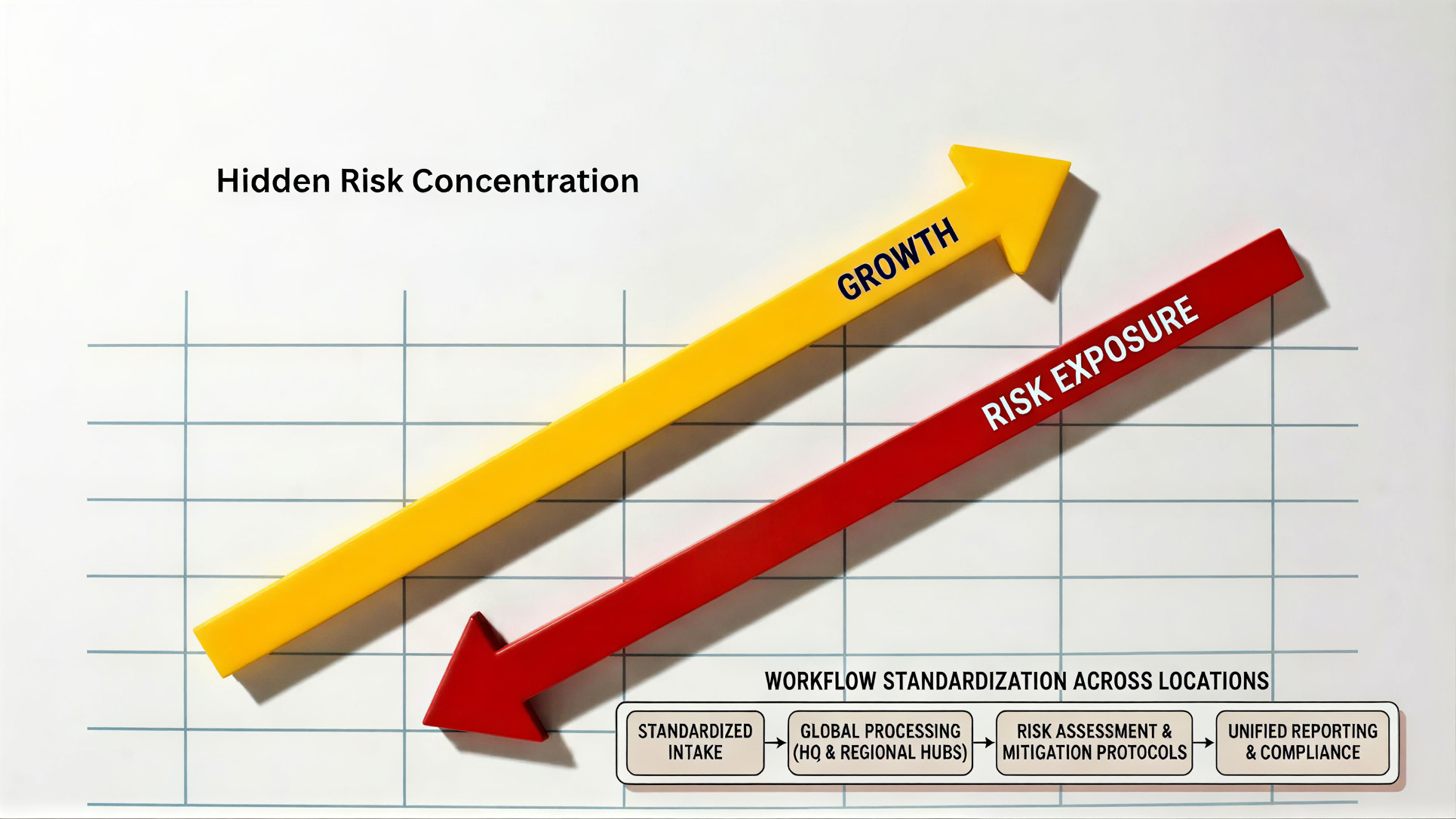
Risk Concentration: Identifying Where Exposure Actually Lives
Risk is rarely evenly distributed. It concentrates quietly in specific areas.
Common forms of risk concentration include:
- Revenue heavily dependent on a single payer
- Operational knowledge concentrated in a few individuals
- High-margin products with volatile reimbursement
- Locations operating outside standard processes
These concentrations often go unnoticed until disruption occurs. A contract change, staff departure, or audit can trigger cascading failures.
Resilient providers actively identify and reduce concentration risk. They diversify payer exposure, document processes thoroughly, and distribute operational knowledge intentionally.
Financial Controls That Support Resilient Scaling
Scaling increases financial complexity. Without appropriate controls, growth destabilizes cash flow.
Key considerations include:
- Cash-flow predictability: Strong billed revenue means little if payment timing is volatile.
- Accounts receivable stability: Rising A/R often signals workflow breakdowns during expansion.
- Inventory exposure: Overstocking during growth ties up capital and increases audit risk.
Resilient providers model downside scenarios before expanding. They ask not only “How much can we grow?” but “How much disruption can we absorb?”
Growth decisions grounded in financial discipline reduce surprise and preserve flexibility.
Compliance as a Scaling Constraint, Not a Back-End Fix
Compliance failures rarely occur because providers ignore regulations. They occur because compliance lags behind growth.
As organizations expand:
- Documentation volume increases
- Oversight becomes harder
- Inconsistencies spread across teams
Under 42 CFR § 424.57, DMEPOS suppliers remain accountable for compliance regardless of size or complexity. Scaling without embedding compliance into workflows increases audit exposure significantly.
Resilient providers treat compliance as infrastructure. They integrate requirements into intake, documentation, delivery, and billing processes rather than addressing issues after the fact.
Technology as a Risk Multiplier or Risk Buffer
Technology can either strengthen resilience or amplify risk.
When workflows are stable, technology:
- Enforces consistency
- Improves visibility
- Supports scalability
When workflows are unstable, technology:
- Scales errors
- Obscures accountability
- Creates false confidence
Resilient scaling requires intentional technology adoption. Automation must be governed, monitored, and aligned with standardized processes. Tools should reinforce discipline, not replace it.
Leadership and Decision Discipline During Expansion
Leadership behavior sets the ceiling for resilience.
During expansion, leaders face pressure to move quickly. The most resilient organizations resist that pressure. They:
- Define clear criteria for expansion readiness
- Set boundaries around acceptable risk
- Pause growth when infrastructure lags
Leadership discipline ensures that growth decisions are deliberate rather than reactive. Resilience is built through restraint as much as ambition.
Metrics That Signal Resilience Before Failure Occurs
Lagging indicators reveal problems after damage is done. Resilient organizations monitor leading indicators, including:
- Intake fallout rates
- First-pass claim acceptance
- Documentation rework frequency
- Cash-flow timing variance
These metrics signal stress early. Providers that respond proactively avoid cascading failures during growth.
Common Scaling Mistakes That Undermine Resilience
Providers often compromise resilience when they:
- Expand before stabilizing existing operations
- Over-rely on key individuals
- Assume volume offsets margin erosion
- Treat compliance as an afterthought
Each mistake increases exposure incrementally. Combined, they undermine growth entirely.
How Wonder Worth Solutions Helps DME Providers Scale Safely
Wonder Worth Solutions supports DME providers by evaluating operational readiness before expansion, stabilizing workflows, identifying hidden risks, and aligning growth strategies with compliance and financial discipline.
The goal is not to limit growth, but to ensure growth is sustainable.
Conclusion: Sustainable Growth Is an Engineered Outcome
In 2026, growth without resilience is a liability. DME providers that engineer stability into workflows, financial controls, compliance practices, and leadership decisions are the ones able to scale without increasing risk.
Resilience is not accidental. It is designed.