Answer Summary
Cloud-based billing software stabilizes the DME revenue cycle by centralizing multi-location access and automating updates to ensure compliance with shifting payer rules. As Electronic Prior Authorization (e-PA) becomes mandatory on January 1, 2026, transitioning to cloud-native platforms allows providers to meet these digital requirements while targeting a 25% reduction in Days Sales Outstanding (DSO). By replacing fragmented legacy systems with real-time, vendor-managed infrastructure, organizations can scale their operations without increasing the risk of documentation gaps or administrative bottlenecks.
Introduction: Why Cloud Billing Became a Strategic Decision
For years, cloud-based billing software was positioned as a technology upgrade—something driven by IT teams looking to reduce server maintenance or support remote access. In 2026, that framing no longer fits reality for DME providers.
Billing instability, staffing challenges, compliance pressure, and multi-location operations have pushed cloud billing from a convenience to a strategic operational decision. Providers are no longer asking whether cloud systems work, but whether they strengthen or weaken control over the revenue cycle.
Cloud adoption can stabilize workflows, improve visibility, and support growth. It can also introduce rigidity, vendor dependency, and compliance blind spots if implemented without discipline. The difference lies not in the software itself, but in how providers evaluate and govern it.
What “Cloud-Based Billing” Actually Means for DME Providers
One of the biggest sources of confusion in vendor discussions is the term “cloud.”
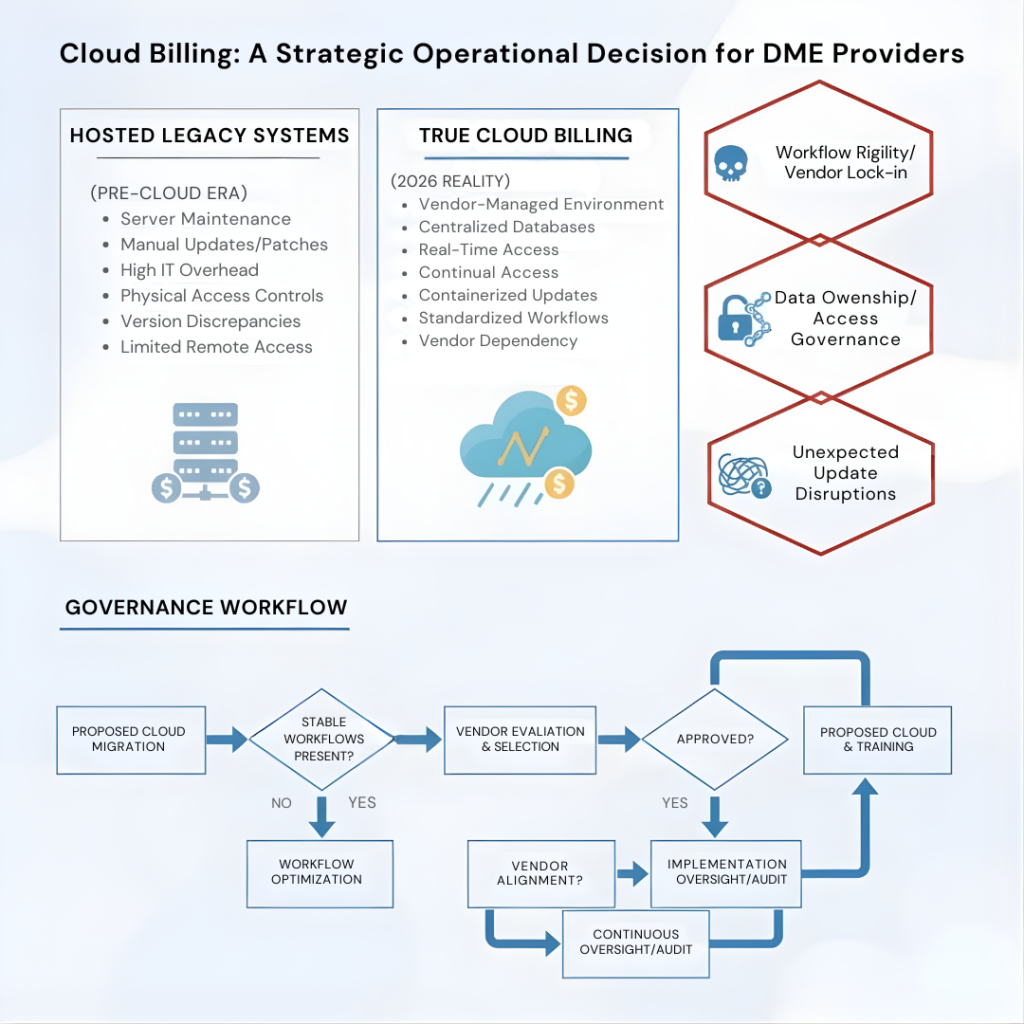
True cloud-based billing systems are designed to operate entirely within a vendor-managed environment, with centralized databases, real-time access, and continuous updates. This is fundamentally different from hosted legacy systems that simply move old software onto remote servers.
For DME providers, this distinction matters because cloud systems:
- Centralize access across locations and teams
- Apply updates universally and automatically
- Limit customization in favor of standardization
- Shift certain controls from internal IT to the vendor
These characteristics reshape how billing workflows behave. Providers gain visibility and scalability, but they also relinquish some control. Understanding this trade-off is critical before migration.
Operational Benefits Providers Expect—and Often Get
When cloud billing is implemented thoughtfully, providers often experience real operational gains.
Centralized Access and Visibility
Cloud platforms allow intake, billing, and A/R teams to work from the same system regardless of location. This reduces handoff delays and eliminates version discrepancies that plague on-premise setups.
Scalability During Growth
As providers add locations or volume, cloud systems scale without requiring new infrastructure. This flexibility supports expansion without the delays associated with hardware procurement or system replication.
Support for Remote and Hybrid Teams
In 2026, remote billing is no longer exceptional. Cloud billing enables secure access for distributed teams while maintaining centralized oversight.
These benefits are real—but they materialize only when workflows are already stable.
Where Cloud Billing Improves Revenue Cycle Performance
Beyond convenience, cloud billing can materially improve revenue cycle outcomes.
Faster Workflow Handoffs
Real-time access allows intake and billing teams to work concurrently rather than sequentially. Documentation issues are identified earlier, reducing downstream rework.
Improved Reporting and Audit Trails
Cloud systems often provide more consistent logging, version tracking, and reporting capabilities. This supports audit readiness and internal monitoring.
Reduced Manual Reconciliation
Centralized data reduces discrepancies between systems, especially in multi-location environments where reconciliation was previously manual.
These improvements strengthen first-pass claim acceptance and A/R visibility—but only when data quality and workflow discipline are present.
The Hidden Pitfalls Providers Discover Too Late
Despite their advantages, cloud billing systems introduce risks that many providers underestimate.
Workflow Rigidity
Standardization is a strength of cloud systems, but it can become a weakness when payer nuance or unique operational needs arise. Providers may find that “best practice” workflows do not align perfectly with their payer mix.
Vendor-Controlled Update Cycles
Automatic updates ensure consistency, but they can also introduce changes without sufficient preparation. If workflows are not governed internally, updates can disrupt operations unexpectedly.
Data Ownership and Exit Challenges
Extracting data from cloud platforms can be complex. Providers that fail to evaluate exit strategies upfront may find themselves locked into systems that no longer serve them.
These pitfalls do not negate the value of cloud billing—but they require proactive management.
Compliance and Audit Considerations in the Cloud
Cloud billing does not reduce compliance responsibility. Under 42 CFR § 424.57, DMEPOS suppliers remain fully accountable for documentation integrity, billing accuracy, and record retention regardless of system architecture.
Key considerations include:
- Ensuring documentation is stored securely and retrievable
- Maintaining clear audit trails for changes and corrections
- Applying role-based access controls consistently
- Avoiding assumptions that “the system handles compliance”
Auditors evaluate outcomes and controls, not technology labels. Cloud systems must therefore be configured and governed to support defensibility.
Data Security, Access, and Accountability
Security is often cited as both a benefit and a concern with cloud billing.
Cloud vendors typically invest heavily in infrastructure security, often exceeding what individual providers can maintain internally. However, security risks shift from physical access to access governance.
Providers must define:
- Who has access to which functions
- How access is granted and revoked
- How vendor access is monitored
- Who is accountable when issues occur
Without clear governance, cloud access can become a blind spot rather than a safeguard.
Cloud Billing and Workflow Governance
Governance becomes more important—not less—in cloud environments.
Because changes apply system-wide, providers must establish controls around:
- Workflow modifications
- User permissions
- Update testing and communication
- Error identification and rollback
Cloud systems amplify both good and bad processes. Governance ensures they amplify the right ones.
Financial Implications Beyond Subscription Cost
Cloud billing is often sold on predictable subscription pricing. While important, subscription fees represent only part of the financial picture.
Providers should evaluate:
- Total cost of ownership over time
- Cost of downtime or vendor outages
- Training and adoption effort
- Switching and exit risk
ROI depends not just on cost savings but on how well the system supports stable operations.
Selecting a Cloud Billing Platform: What Providers Should Evaluate
Before migrating, providers should assess:
- Alignment with DME-specific workflows
- Vendor transparency around updates and data access
- Reporting flexibility
- Support responsiveness
- Clear exit and data portability options
Selection should be a joint decision involving operations, compliance, finance, and leadership—not IT alone.
Common Cloud Adoption Mistakes DME Providers Make
Providers often struggle when they:
- Move unstable workflows into the cloud
- Underestimate training requirements
- Assume cloud equals compliance
- Treat adoption as a one-time event
Each mistake increases dependency without increasing control.
How Wonder Worth Solutions Helps Providers Evaluate Cloud Billing
Wonder Worth Solutions helps DME providers assess readiness for cloud migration, stabilize workflows before transition, evaluate vendors objectively, and design governance structures that protect compliance and operational control.
The focus is informed adoption—not rushed migration.
Conclusion: Cloud Billing Is an Operational Commitment
Cloud-based billing software in 2026 is not just a technology choice—it is an operational commitment. When adopted intentionally, it strengthens visibility, scalability, and control. When adopted hastily, it magnifies risk.
DME providers that evaluate cloud billing through an operational lens position themselves for stability and adaptability in an increasingly complex reimbursement environment.