
Answer Summary
AI overviews and generative search experiences are changing how healthcare and DME information are discovered. In 2026, DME providers that structure content clearly, cite authoritative sources, and demonstrate real operational expertise are more likely to be surfaced (and trusted) by AI-driven answer engines.
Introduction
Search isn’t just “search” anymore. Decision-makers are increasingly getting answers directly from AI summaries and generative tools—often without clicking through to websites. That doesn’t mean your content is irrelevant. It means your content has to be extractable, credible, and well-structured.
For DME providers, that’s a big deal. Your industry is technical, regulated, and full of nuance—exactly the kind of environment where AI systems lean heavily on sources that appear consistent, authoritative, and experience-based.
This FAQ explains what AI Overviews and GEO are, why they matter for DME in 2026, and what practical steps you can take to improve visibility without chasing gimmicks.
FAQ: What are AI Overviews?
AI Overviews are AI-generated summaries shown in search results that attempt to answer a user’s question immediately. They often include citations to sources used to create the summary.
Why it matters: If your content is structured well, your brand may be referenced as a trusted source—sometimes before a user ever visits your site.
FAQ: What is Generative Engine Optimization (GEO)?
GEO is the practice of optimizing content so it is more likely to be selected, quoted, or referenced by AI-driven search and generative engines.
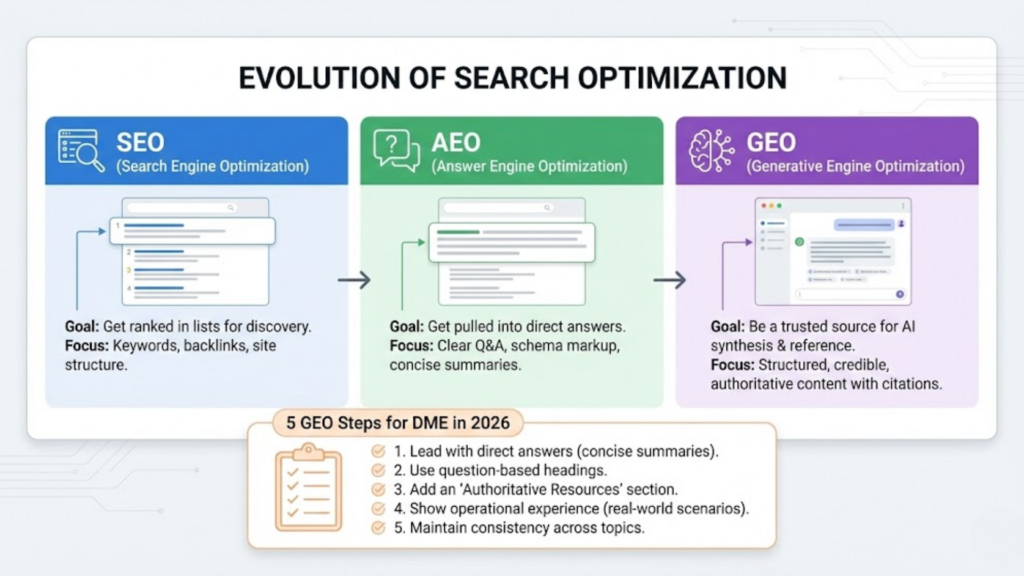
GEO overlaps with SEO and AEO (Answer Engine Optimization), but GEO leans harder on:
- Clarity and completeness of explanations
- Authority signals (credible sources, compliance grounding)
- Demonstrated experience (real-world workflows, examples, specifics)
FAQ: Is GEO replacing SEO?
No. SEO is still essential. GEO is an additional layer.
A simple way to think about it:
- SEO: helps you get discovered in rankings
- AEO: helps you get pulled into direct answers
- GEO: helps AI systems treat your content as a reliable reference when generating responses
In 2026, the winners are doing all three—without turning their content into keyword soup.
FAQ: Why does this matter specifically for DME providers?
Because DME decision-making is high-stakes and detail-heavy:
- Billing and coding accuracy impacts reimbursement
- Documentation impacts denials and audit risk
- Policy changes can affect operational workflows
AI systems are more likely to surface content that:
- Uses clear headings and direct answers
- Reflects compliance and operational reality
- References authoritative sources like CMS and recognized associations
If your content reads like generic healthcare marketing, it won’t stand out.
FAQ: What type of content does AI tend to surface?
AI systems tend to favor content that is:
- Structured: strong H2/H3 headings, bullet lists, short answer summaries
- Specific: examples, decision points, measurable outcomes
- Credible: references to authoritative resources
- Consistent: aligns with what other trusted sources say (without copying)
For DME, “specific” often means:
- Common denial root causes and how to prevent them
- Workflow standards that reduce coding variability
- Practical steps that align with payer expectations
FAQ: What are 5 practical GEO steps DME providers can take in 2026?
1) Lead with direct answers
Start blogs with a 2–3 sentence summary that directly answers the main question.
2) Use question-based headings
Write headings the way people ask questions:
- “What triggers DME denials most often?”
- “How do I reduce coding variability across staff?”
3) Add an “Authoritative Resources” section
This builds credibility and makes it easier for AI to validate claims.
4) Show operational experience
Add real-world scenarios (even anonymized):
- “If you process 4,000 claims/month…”
- “If one location uses different modifiers…”
5) Maintain consistency across topics
If you publish about coding, denials, and compliance, keep definitions and recommended workflows consistent across posts.
How Wonder Worth Solutions Helps
Wonder Worth Solutions supports DME providers with content and revenue-cycle expertise that is built for the 2026 discovery environment—clear enough for AI to reference and practical enough for teams to implement.
Authoritative Resources Referenced
- CMS (Centers for Medicare & Medicaid Services) guidance and manuals
- 42 CFR § 424.57 (DMEPOS Supplier Standards)
- AAHomecare educational and compliance resources
- Accreditation body guidance (e.g., ACHC)
Conclusion
In 2026, content visibility is no longer only about ranking—it’s about being trusted, extractable, and consistent. DME organizations that publish clear, operationally grounded guidance will be more likely to appear in AI-generated answers—and more likely to win trust early in the decision process.