Answer Summary
Efficient patient onboarding reduces documentation errors, accelerates billing, and improves patient satisfaction. In 2026, HME providers that standardize and digitize onboarding workflows see fewer denials, faster reimbursement, and a stronger compliance posture.
Introduction: Why Patient Onboarding Is a Revenue Issue
Patient onboarding is often treated as a front-desk task. In reality, it is one of the most consequential revenue-cycle touchpoints in the HME workflow.
Incomplete intake data, missing signatures, and inconsistent documentation frequently lead to:
- Claim rejections
- Medical necessity denials
- Delayed authorizations
- Rework downstream
In 2026, payers expect documentation accuracy from the first interaction—not after corrections.
What “Onboarding” Actually Includes for HME Providers
Effective onboarding spans:
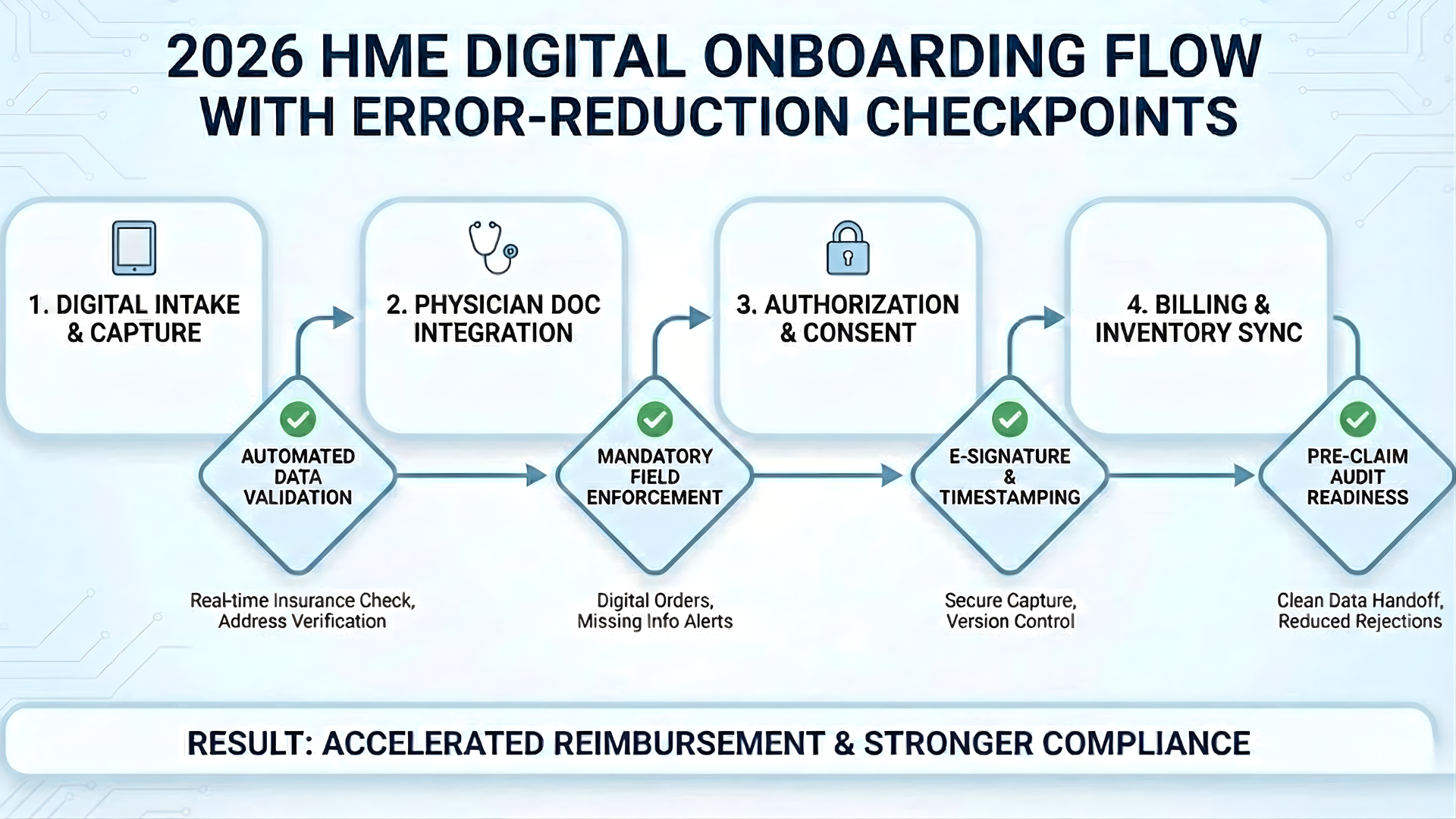
- Patient demographics and insurance capture
- Physician documentation intake
- Authorization verification
- Consent and assignment of benefits
- Product-specific documentation requirements
Under 42 CFR § 424.57, suppliers must maintain accurate, accessible records. Errors introduced during onboarding ripple through the entire revenue cycle.
Common Onboarding Failure Points
Most onboarding issues stem from:
- Manual data entry
- Paper forms
- Disconnected systems
- Inconsistent staff processes
These failures are rarely visible until claims are denied.
How Digital Onboarding Reduces Risk
Digitized onboarding workflows:
- Enforce required fields
- Reduce transcription errors
- Standardize documentation across staff
- Improve audit readiness
Automation acts as a guardrail—not a shortcut.
Impact on Denials and A/R
Providers that modernize onboarding often experience:
- Fewer front-end claim rejections
- Faster authorization turnaround
- Reduced downstream rework
- Improved days in A/R
Small improvements at intake produce outsized financial results.
Compliance Considerations
Digital onboarding supports compliance by:
- Timestamping documentation
- Maintaining version control
- Creating clear audit trails
CMS reviewers increasingly look for process consistency, not just completed forms.
Implementation Considerations
Successful onboarding optimization requires:
- Clear documentation standards
- Staff training on new workflows
- Integration with billing and inventory systems
- Ongoing monitoring
Technology alone does not fix broken processes.
How Wonder Worth Solutions Helps
Wonder Worth Solutions helps HME providers design onboarding workflows that reduce errors, protect compliance, and accelerate reimbursement—without disrupting patient experience.
Authoritative Resources Referenced
- 42 CFR § 424.57—DMEPOS Supplier Standards
- CMS Medicare Program Integrity Manual, Chapter 5
- CMS MLN Matters: Documentation & Enrollment Guidance
- AAHomecare Operational Best Practices
Conclusion
In 2026, patient onboarding is not administrative—it’s foundational. Providers that invest in accurate, standardized intake protect both revenue and reputation.