

Answer Summary
Revenue diversification protects RCM and DME-adjacent organizations from payer shifts, client churn, and reimbursement volatility. In 2026, the best diversification strategies are adjacent, compliance-safe, and built on existing strengths—so growth reduces risk instead of creating new operational burden.
Introduction
If your revenue depends heavily on one payer, one service line, or a handful of large clients, you’re not alone. But in 2026, revenue concentration is a fragile place to live.
- Payer rules change
- Review activity increases
- Contract terms tighten
- Client priorities shift quickly
Diversification isn’t about chasing random new services. It’s about building a stronger business that can absorb pressure without panic.
Below are practical, realistic diversification moves—plus guardrails to keep you from creating compliance or delivery risk.
Step 1: Diagnose Your Revenue Concentration
Before you diversify, quantify the risk.
Track:
- % revenue by top payer
- % revenue by top 5 clients
- % revenue by service line
- % revenue tied to one referral channel or product category (if applicable)
Rule of thumb: If one element dominates your revenue mix, it becomes a single point of failure.
Step 2: Choose “Adjacent” Expansion Over Reinvention
The best diversification strategies feel like a natural extension of what you already do well.
Adjacent expansion typically:
- Requires less retraining
- Keeps quality high
- Maintains compliance clarity
- Produces faster time-to-value
Reinvention tends to:
- Create delivery inconsistency
- Increase documentation risk
- Dilute focus
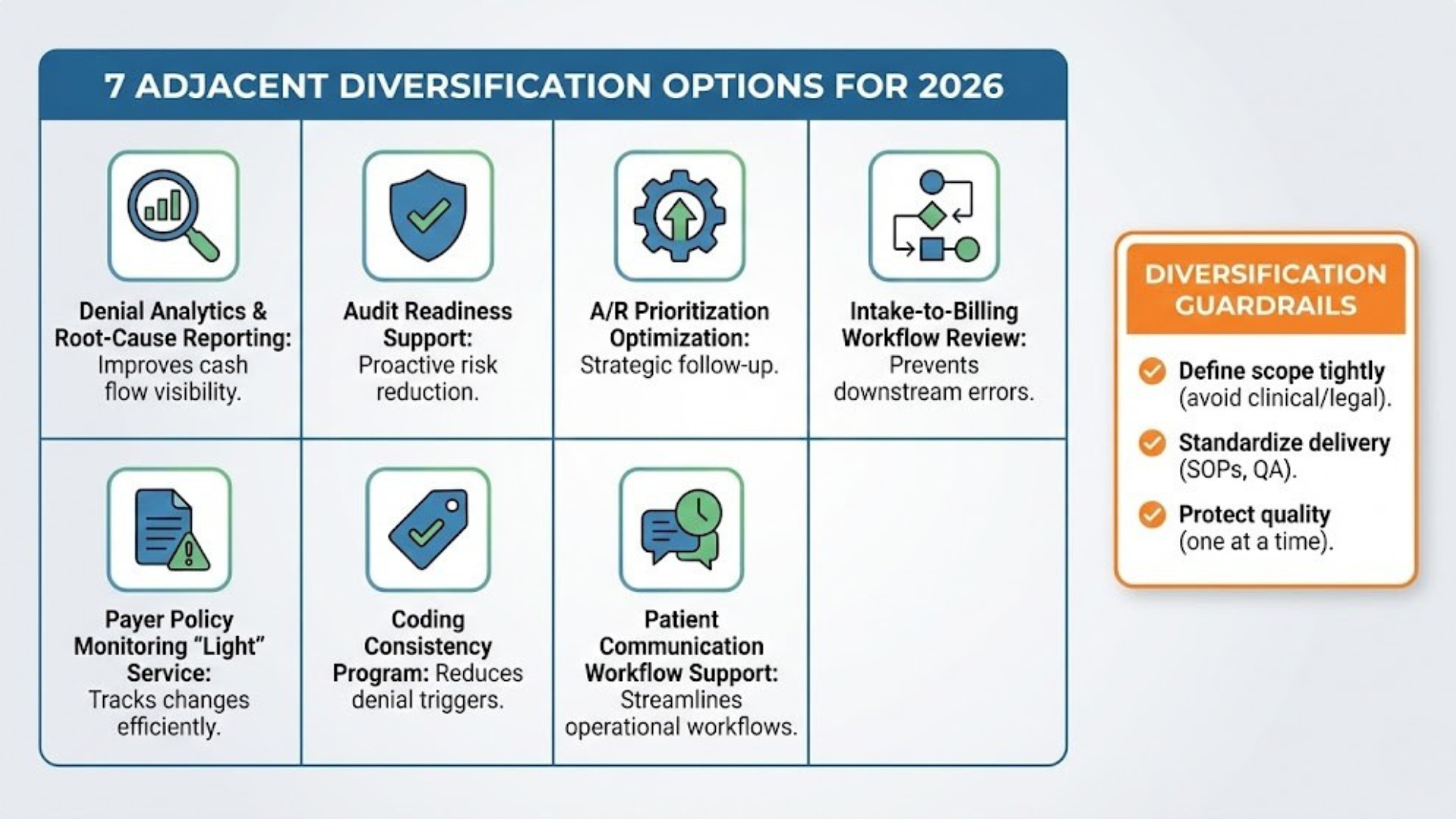
7 Practical Diversification Options for 2026
These are common “safe expansions” for RCM and DME-adjacent teams that want growth without chaos.
1) Denial Analytics & Root-Cause Reporting
Offer clients visibility into:
- Top denial reasons by payer
- Denial trends by product/category
- Preventable vs non-preventable denials
- Documentation gaps driving rework
This is often a strong upsell because it ties directly to cash flow.
2) Audit Readiness Support
Create a service package that includes:
- Documentation consistency checks
- Workflow standardization reviews
- “Audit-ready record” gap assessment
- Basic policy alignment recommendations
This is a natural extension of billing operations.
3) A/R Prioritization Optimization
Many teams do A/R follow-up—but fewer do it strategically.
Differentiate by offering:
- Segmented follow-up strategy (risk/value)
- Payer-behavior insights
- Escalation rules and aging playbooks
- Metrics reporting that leadership actually uses
4) Intake-to-Billing Workflow Review
If you can prevent errors at intake, you reduce downstream cost.
Offer a structured workflow review for:
- onboarding documentation completeness
- authorization capture
- data entry workflows
- handoff clarity between departments
5) Payer Policy Monitoring “Light” Service
Not every organization can afford a full compliance department.
Offer a lightweight monitoring service:
- policy change alerts
- internal workflow update recommendations
- common risk flags by payer
Keep this tight and realistic—don’t overpromise legal interpretation.
6) Coding Consistency Program
Coding variability is a denial and audit trigger.
Offer:
- standard coding references & internal rules
- modifier consistency checks
- training refreshers tied to real denial patterns
- monthly “coding drift” reporting
7) Patient Communication Workflow Support (Operational, not clinical)
For DME-adjacent operations, this can include:
- refill reminders and scheduling coordination workflows
- documentation collection follow-ups
- portal adoption workflows (if applicable)
The key is keeping scope operational and compliant.
Guardrails: How to Diversify Without Creating Risk
Diversification should not increase compliance exposure or degrade delivery.
Use these guardrails:
- Define scope tightly: What you do and do not do (especially around clinical decisions)
- Standardize delivery: SOPs, templates, QA checklists
- Protect quality: Don’t launch 3 new services at once
- Measure outcomes: revenue per service line, churn rate, margin, delivery capacity
- Ensure compliance alignment: Documentation, process consistency, audit readiness
If a new service requires “heroics” to deliver, it’s not ready.
How Wonder Worth Solutions Helps
Wonder Worth Solutions helps RCM and DME-adjacent organizations evaluate diversification opportunities through a compliance-first operational lens—so new revenue strengthens the business rather than stretching it.
Conclusion
In 2026, diversification isn’t a growth trend—it’s a stability strategy. The best moves are adjacent, operationally realistic, and anchored in standardization. When done correctly, diversification protects margin, reduces risk, and makes your business more resilient.