Answer Summary
By standardizing workflows across intake, scheduling, documentation, and billing, a multi-location DME provider improved patient satisfaction scores while reducing staff workload and processing delays. The changes increased consistency, reduced rework, and created a more predictable operational environment without adding staff.
Background
The provider was a growing DME organization operating across multiple locations with a strong patient base and experienced staff. Despite steady demand, leadership began noticing warning signs:
- Patient complaints about delayed responses and follow-ups
- Staff reporting burnout and frustration
- Inconsistent turnaround times for orders and billing
- Rising internal rework despite similar patient volumes
On paper, the organization appeared well-run. In practice, daily operations relied heavily on individual staff knowledge and location-specific habits.
Leadership recognized that growth had outpaced process discipline.
The Challenge: When Experience Replaces Structure
The core issue was not lack of effort or expertise. It was workflow inconsistency.
Key challenges included:
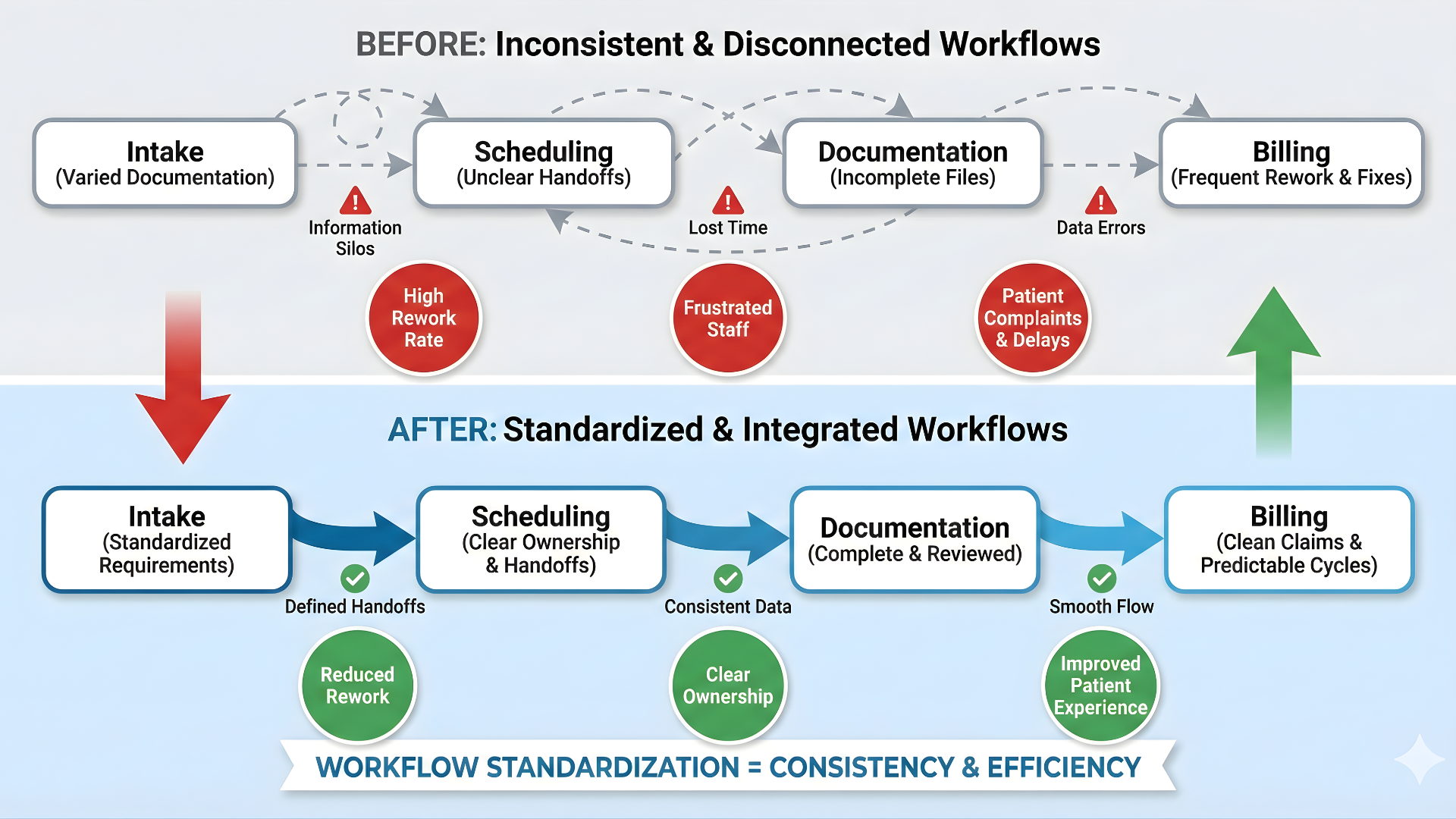
- Intake documentation varied by staff member
- Scheduling handoffs were unclear between departments
- Billing teams frequently had to “fix” incomplete files
- Patient communication depended on who handled the request
Because workflows were informal, problems only surfaced downstream—often as delays, rework, or patient dissatisfaction.
Importantly, none of these issues were catastrophic on their own. But together, they created friction that compounded daily.
The Objective
Leadership set out to improve two things simultaneously:
- Patient experience — faster responses, clearer communication, fewer delays
- Staff efficiency — less rework, fewer interruptions, clearer expectations
The goal was not speed at all costs. It was predictability and consistency.
The Solution: Workflow Standardization Across the Lifecycle
Rather than implementing new technology immediately, the provider focused first on standardizing how work moved through the organization.
Key actions included:
1. Defining Standard Intake Requirements
Clear documentation requirements were established by product and payer type. Intake staff knew exactly what was required before files moved forward.
2. Clarifying Handoffs Between Departments
Ownership was clearly defined at each stage:
- Intake
- Scheduling
- Documentation review
- Billing
This reduced confusion and prevented files from stalling between teams.
3. Creating Consistent Patient Communication Touchpoints
Patients received clearer expectations regarding timelines, follow-ups, and next steps—regardless of location or staff member.
4. Reducing Unnecessary Exceptions
Instead of allowing “workarounds,” the organization focused on fixing root causes that created exceptions in the first place.
Standardization was positioned not as rigidity, but as support for staff.
Implementation: Making Change Stick
Change management was critical.
Leadership emphasized:
- Why standardization mattered
- How it reduced stress and rework
- That feedback would be used to refine workflows
Staff were trained on what changed and why, not just what to do differently.
Importantly, workflows were tested and adjusted before full rollout—avoiding the “set it and forget it” trap.
The Results
Within several months, the provider saw measurable improvements:
- Patient satisfaction scores increased, driven by faster responses and clearer communication
- Staff rework declined, reducing frustration and overtime
- Turnaround times became more predictable, even during high-volume periods
- Internal escalation volume dropped, freeing leadership time
Perhaps most importantly, the organization gained operational visibility. Leaders could now identify where delays occurred—and address them systematically.
Why This Worked
The success was not tied to a single tool or hire. It came from:
- Removing ambiguity from workflows
- Aligning expectations across teams
- Reducing reliance on individual heroics
- Treating efficiency and patient experience as connected outcomes
Standardization created breathing room for staff and clarity for patients.
How Wonder Worth Solutions Helped
Wonder Worth Solutions supported the provider by helping map existing workflows, identify friction points, and design standardized processes aligned with billing and compliance requirements.
The focus was not on speed alone but on repeatable, sustainable performance.
Conclusion
This case study reinforces a key lesson for DME providers in 2026:
Improving patient satisfaction does not require staff to work harder.
It requires workflows to work better.
By standardizing how work moves through the organization, this provider reduced friction, improved experience, and created a stronger foundation for future growth.